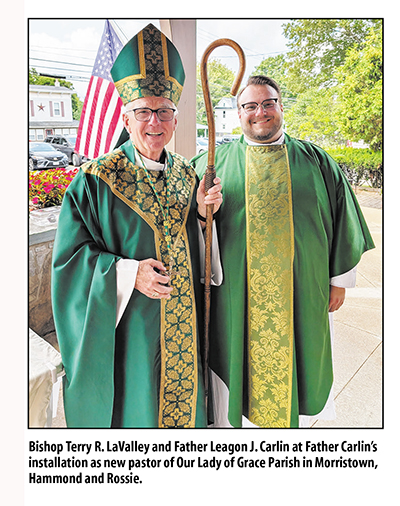





October 7, 2026 By Darcy Fargo Having completed his studies in Canon Law at St. Paul University in Ottawa, Father Leagon J. Carlin, now pastor of Our Lady of Grace Parish in Morristown, Hammond and Rossie and vice chancellor and adjutant judicial vicar for the Diocese of Ogdensburg, says he is settling into his new roles and this new part of his ministry. “It’s an honor to be asked to serve in various capacities, and I look forward to whatever the Lord wants me doing here,” said Father Carlin. “It’s exciting to be given good diversity of work. It says in scripture, ‘behold, I make all things new.’ I’ve certainly experienced a lot of newness in my vocational discernment and living my vocation. Right now, it’s a lot of newness all at once, and that’s a gift if I let it be a gift. God is doing something here, and Jesus makes all things new and ancient at the same time. I’m excited for this adventure – for both the newness and the bit of stability.” While he enjoys the diversity of the role, Father Carlin said the stability of his parish and his new role as pastor are his priority. “My primary responsibility is to the people of the parish and to be their pastor,” he said. “Fatherhood is first. It’s been said to me by various people (in the diocesan offices) that, for example, if there’s a funeral or some other need in the parish that makes it so I can’t be in the office, that’s understandable.” Father Carlin said he looks forward to growing as a pastor. “It’s often said being a parochial vicar is like being a fun uncle,” he said. “You get to do all the cool stuff – be with people, love people, bring Jesus to them and be present to them, but you don’t have to make the hard choices, get the roof fixed and sign the checks. To be the father of a parish, to be the one shepherding this slice of the diocese, is new and exciting but also daunting.” In his role as vice chancellor, Father Carlin supports diocesan administration and the various offices and departments of the diocese. “I’m working in the areas of administration, both internal curial administration – working with the people who work here and the offices here – and external administration, working on the broader administrative needs of the diocese,” he said. “I’m working alongside people who have done these jobs, and I’m doing my best to assist. I’m answering questions I’m qualified to answer and directing questions I’m not qualified to answer to the right individuals or offices.” Father Carlin serves the Tribunal primarily on Wednesdays. “That’s the day I spend reading cases and writing briefs and documents,” he said. “There’s flexibility in that, and I’m still working on the order of things. I’m very much a believer that we need to have a plan but be flexible.” Father Carlin said his work in the Tribunal, overseen by Judicial Vicar Father Garry B. Giroux, can include a variety of topics related to Canon Law, but it tends to be focused on the Marriage Tribunal. “We’re looking at cases of pretty painful or difficult moments of peoples’ lives through the lens of Church law and with the mercy and justice of the Father,” he said. “It’s about finding the truth of the case, and that involves a lot of paperwork. The paperwork ensures people’s rights are being respected, and procedures are being done well and with justice and order, themselves acts of charity. It’s asking questions of people at interviews, gathering evidence, looking at the facts of each case, reading documents and determining what is present and not present.” Father Carlin said he enjoyed learning about Canon Law and how to apply it. In addition to marriage law, Canon Law includes rules and procedures for the administration of temporal goods – “stuff the Church owns,” Father Carlin explained. It also defines and regulates how rules are made and applied, the hierarchy, laity and consecrated life, ministries, schools, communications, sacraments, worship, sacred places, crimes and penalties and processes. “A lot of people aren’t familiar with Canon Law or know it only as a red book full of rules,” he said. “It is a red book full of rules, but good people have good rules. It helps us to treat each other well and know where we stand. The laws of the Church, like God’s law, are not designed as some kind of oppression; it’s for the protection of rights and to help us live together in harmony – like all good laws. Canon Law isn’t something to be afraid of. The Law of the Lord is to love, and as it says in the final Canon in the code, salvation of souls is the supreme law of the Church.” He said studying Canon Law suited him well given his natural interest in law, systems and procedures. “I find the law very interesting,” Father Carlin said. “I’ve had a disposition for that kind of thinking since I was a kid. I’m oriented toward and motivated by justice and fair treatment. The idea of the law being for the protection of rights and integration of responsibilities comes naturally to me.” Father Carlin said his seminary, Mount St. Mary’s Seminary in Maryland, also gave him a strong early formation in Canon Law. “At the Mount, we learned what I discovered later was a remarkable amount about Canon Law compared with what other seminaries offer,” he said. “I left with a grasp of the fundamentals of marriage law, at least, and Canon Law of the sacraments – what makes Mass valid, Confession valid, what’s required for the celebration of the sacraments, what words can be changed and what words can’t.” While he acknowledged his new roles are complex, Father Carlin said he sees opportunities to grow through the complexities. “I’m excited to learn how to trust the Lord better – the process of a lifetime,” he said. “And I’m excited to see what God is doing. Studying the law of the Church and in my small amount of exercising the law, it’s become so much clearer how Canon Law is a ministry of mercy. The three words that are on my heart – just, clear and healing. I don’t know if there are three things more necessary in the world today than justice, clarity and healing. To do law well in an ecclesiastical context is to bring about those three great virtues.” |
||||
|
|||||||||